 Add to Chrome
 Add to Firefox
 Add to Edge
FLARE: Diffusion for Hybrid Language Model
Jun 01, 2026
Autoregressive (AR) large language models (LLMs) have achieved broad practical success, but sequential decoding remains a key bottleneck for low-latency deployment. Recent efficient-inference work has progressed along two axes: reducing the cost of each model invocation through efficient architectures, and reducing serial decoding steps through parallel generation. Hybrid attention backbones address the former, while diffusion language models (dLLMs) pursue the latter via iterative parallel denoising. Combining these advantages remains challenging: AR-to-dLLM conversion often fails to preserve seed-checkpoint capability, and hybrid-attention recurrent states and masking constraints make diffusion training and serving nontrivial. We present FLARE, a systematic conversion framework for hybrid-attention LLMs. Our analysis identifies transfer data quality as the primary determinant of capability preservation, outweighing loss formulation and attention-mask design. The resulting framework combines a token-equal AR-and-diffusion objective, hardware-aware kernels, and unified inference, enabling one checkpoint to support both AR-style verified decoding and diffusion-style parallel denoising. Starting from strong AR checkpoints with limited post-training data, FLARE is competitive with leading open-source dLLMs across model scales and delivers consistent throughput gains over open-source dLLM baselines in single-GPU concurrent serving. Our results further suggest that practical dLLMs are limited not only by decoding algorithms, but also by transfer data quality and the training inefficiency of current block-diffusion objectives, motivating joint design of data, objectives, architectures, and inference systems.

MetaDNS: Enhancing Exploration in Discrete Neural Samplers via Well-Tempered Metadynamics
May 20, 2026Sampling from discrete distributions with multiple modes and energy barriers is fundamental to machine learning and computational physics. Recent discrete neural samplers like MDNS suffer from mode collapse and fail to sample high-energy barrier regions between modes, which is critical for free energy estimation and understanding phase transitions. We propose Metadynamics Discrete Neural Sampler (MetaDNS), a general framework integrating well-tempered metadynamics into discrete diffusion or autoregressive samplers. By maintaining an adaptive, history-dependent bias potential along selected low-dimensional coordinates, MetaDNS forces exploration of previously inaccessible regions, enabling free energy reconstruction infeasible with standard neural samplers due to a lack of high-energy samples. On challenging low-temperature benchmarks including Ising, Potts, and the copper-gold binary alloy, MetaDNS reproduces the thermodynamic distribution. Compared to MCMC-based metadynamics, MetaDNS also achieves comparable exploration requiring fewer bias deposition steps.
Efficient Diffusion Models under Nonconvex Equality and Inequality constraints via Landing
Apr 20, 2026Generative modeling within constrained sets is essential for scientific and engineering applications involving physical, geometric, or safety requirements (e.g., molecular generation, robotics). We present a unified framework for constrained diffusion models on generic nonconvex feasible sets $Σ$ that simultaneously enforces equality and inequality constraints throughout the diffusion process. Our framework incorporates both overdamped and underdamped dynamics for forward and backward sampling. A key algorithmic innovation is a computationally efficient landing mechanism that replaces costly and often ill-defined projections onto $Σ$, ensuring feasibility without iterative Newton solves or projection failures. By leveraging underdamped dynamics, we accelerate mixing toward the prior distribution, effectively alleviating the high simulation costs typically associated with constrained diffusion. Empirically, this approach reduces function evaluations and memory usage during both training and inference while preserving sample quality. On benchmarks featuring equality and mixed constraints, our method achieves comparable sample quality to state-of-the-art baselines while significantly reducing computational cost, providing a practical and scalable solution for diffusion on nonconvex feasible sets.
How Does the ReLU Activation Affect the Implicit Bias of Gradient Descent on High-dimensional Neural Network Regression?
Mar 05, 2026Overparameterized ML models, including neural networks, typically induce underdetermined training objectives with multiple global minima. The implicit bias refers to the limiting global minimum that is attained by a common optimization algorithm, such as gradient descent (GD). In this paper, we characterize the implicit bias of GD for training a shallow ReLU model with the squared loss on high-dimensional random features. Prior work showed that the implicit bias does not exist in the worst-case (Vardi and Shamir, 2021), or corresponds exactly to the minimum-l2-norm solution among all global minima under exactly orthogonal data (Boursier et al., 2022). Our work interpolates between these two extremes and shows that, for sufficiently high-dimensional random data, the implicit bias approximates the minimum-l2-norm solution with high probability with a gap on the order $Θ(\sqrt{n/d})$, where n is the number of training examples and d is the feature dimension. Our results are obtained through a novel primal-dual analysis, which carefully tracks the evolution of predictions, data-span coefficients, as well as their interactions, and shows that the ReLU activation pattern quickly stabilizes with high probability over the random data.
LaViDa-R1: Advancing Reasoning for Unified Multimodal Diffusion Language Models
Feb 15, 2026Diffusion language models (dLLMs) recently emerged as a promising alternative to auto-regressive LLMs. The latest works further extended it to multimodal understanding and generation tasks. In this work, we propose LaViDa-R1, a multimodal, general-purpose reasoning dLLM. Unlike existing works that build reasoning dLLMs through task-specific reinforcement learning, LaViDa-R1 incorporates diverse multimodal understanding and generation tasks in a unified manner. In particular, LaViDa-R1 is built with a novel unified post-training framework that seamlessly integrates supervised finetuning (SFT) and multi-task reinforcement learning (RL). It employs several novel training techniques, including answer-forcing, tree search, and complementary likelihood estimation, to enhance effectiveness and scalability. Extensive experiments demonstrate LaViDa-R1's strong performance on a wide range of multimodal tasks, including visual math reasoning, reason-intensive grounding, and image editing.
Discrete Adjoint Schrödinger Bridge Sampler
Feb 09, 2026Learning discrete neural samplers is challenging due to the lack of gradients and combinatorial complexity. While stochastic optimal control (SOC) and Schrödinger bridge (SB) provide principled solutions, efficient SOC solvers like adjoint matching (AM), which excel in continuous domains, remain unexplored for discrete spaces. We bridge this gap by revealing that the core mechanism of AM is $\mathit{state}\text{-}\mathit{space~agnostic}$, and introduce $\mathbf{discrete~ASBS}$, a unified framework that extends AM and adjoint Schrödinger bridge sampler (ASBS) to discrete spaces. Theoretically, we analyze the optimality conditions of the discrete SB problem and its connection to SOC, identifying a necessary cyclic group structure on the state space to enable this extension. Empirically, discrete ASBS achieves competitive sample quality with significant advantages in training efficiency and scalability.
Diffusion Model's Generalization Can Be Characterized by Inductive Biases toward a Data-Dependent Ridge Manifold
Feb 05, 2026When a diffusion model is not memorizing the training data set, how does it generalize exactly? A quantitative understanding of the distribution it generates would be beneficial to, for example, an assessment of the model's performance for downstream applications. We thus explicitly characterize what diffusion model generates, by proposing a log-density ridge manifold and quantifying how the generated data relate to this manifold as inference dynamics progresses. More precisely, inference undergoes a reach-align-slide process centered around the ridge manifold: trajectories first reach a neighborhood of the manifold, then align as being pushed toward or away from the manifold in normal directions, and finally slide along the manifold in tangent directions. Within the scope of this general behavior, different training errors will lead to different normal and tangent motions, which can be quantified, and these detailed motions characterize when inter-mode generations emerge. More detailed understanding of training dynamics will lead to more accurate quantification of the generation inductive bias, and an example of random feature model will be considered, for which we can explicitly illustrate how diffusion model's inductive biases originate as a composition of architectural bias and training accuracy, and how they evolve with the inference dynamics. Experiments on synthetic multimodal distributions and MNIST latent diffusion support the predicted directional effects, in both low- and high-dimensions.
Rethinking the Design Space of Reinforcement Learning for Diffusion Models: On the Importance of Likelihood Estimation Beyond Loss Design
Feb 04, 2026Reinforcement learning has been widely applied to diffusion and flow models for visual tasks such as text-to-image generation. However, these tasks remain challenging because diffusion models have intractable likelihoods, which creates a barrier for directly applying popular policy-gradient type methods. Existing approaches primarily focus on crafting new objectives built on already heavily engineered LLM objectives, using ad hoc estimators for likelihood, without a thorough investigation into how such estimation affects overall algorithmic performance. In this work, we provide a systematic analysis of the RL design space by disentangling three factors: i) policy-gradient objectives, ii) likelihood estimators, and iii) rollout sampling schemes. We show that adopting an evidence lower bound (ELBO) based model likelihood estimator, computed only from the final generated sample, is the dominant factor enabling effective, efficient, and stable RL optimization, outweighing the impact of the specific policy-gradient loss functional. We validate our findings across multiple reward benchmarks using SD 3.5 Medium, and observe consistent trends across all tasks. Our method improves the GenEval score from 0.24 to 0.95 in 90 GPU hours, which is $4.6\times$ more efficient than FlowGRPO and $2\times$ more efficient than the SOTA method DiffusionNFT without reward hacking.
Prism: Efficient Test-Time Scaling via Hierarchical Search and Self-Verification for Discrete Diffusion Language Models
Feb 02, 2026Inference-time compute has re-emerged as a practical way to improve LLM reasoning. Most test-time scaling (TTS) algorithms rely on autoregressive decoding, which is ill-suited to discrete diffusion language models (dLLMs) due to their parallel decoding over the entire sequence. As a result, developing effective and efficient TTS methods to unlock dLLMs' full generative potential remains an underexplored challenge. To address this, we propose Prism (Pruning, Remasking, and Integrated Self-verification Method), an efficient TTS framework for dLLMs that (i) performs Hierarchical Trajectory Search (HTS) which dynamically prunes and reallocates compute in an early-to-mid denoising window, (ii) introduces Local branching with partial remasking to explore diverse implementations while preserving high-confidence tokens, and (iii) replaces external verifiers with Self-Verified Feedback (SVF) obtained via self-evaluation prompts on intermediate completions. Across four mathematical reasoning and code generation benchmarks on three dLLMs, including LLaDA 8B Instruct, Dream 7B Instruct, and LLaDA 2.0-mini, our Prism achieves a favorable performance-efficiency trade-off, matching best-of-N performance with substantially fewer function evaluations (NFE). The code is released at https://github.com/viiika/Prism.
Generalization of Diffusion Models Arises with a Balanced Representation Space
Dec 24, 2025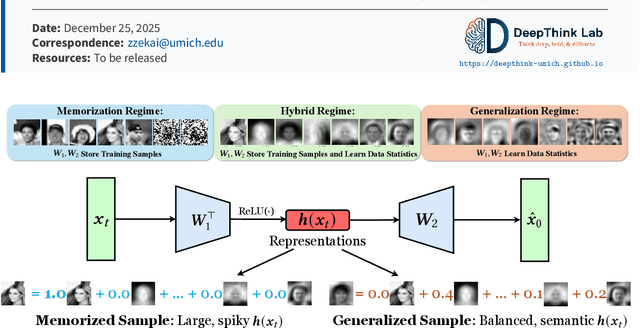
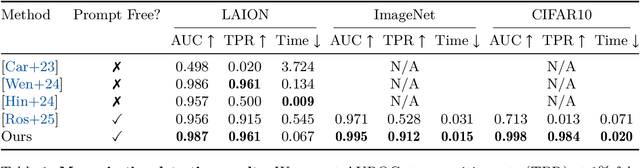
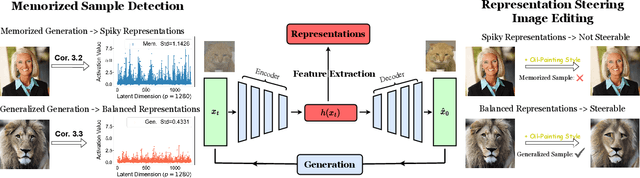
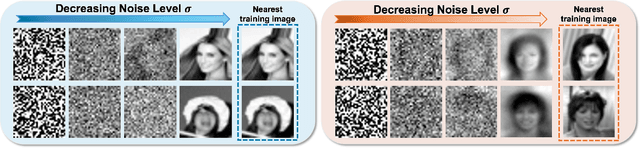
Diffusion models excel at generating high-quality, diverse samples, yet they risk memorizing training data when overfit to the training objective. We analyze the distinctions between memorization and generalization in diffusion models through the lens of representation learning. By investigating a two-layer ReLU denoising autoencoder (DAE), we prove that (i) memorization corresponds to the model storing raw training samples in the learned weights for encoding and decoding, yielding localized "spiky" representations, whereas (ii) generalization arises when the model captures local data statistics, producing "balanced" representations. Furthermore, we validate these theoretical findings on real-world unconditional and text-to-image diffusion models, demonstrating that the same representation structures emerge in deep generative models with significant practical implications. Building on these insights, we propose a representation-based method for detecting memorization and a training-free editing technique that allows precise control via representation steering. Together, our results highlight that learning good representations is central to novel and meaningful generative modeling.